Kategorie
Reverse Engineering & Digital Reconstruction
Reverse engineering is a crucial process in product design and manufacturing that involves analyzing an existing physical object to recreate, optimize, or document its digital design. By converting physical parts into high-precision 3D CAD models, engineers can restore legacy components, inspect manufactured parts, and accelerate prototype development.
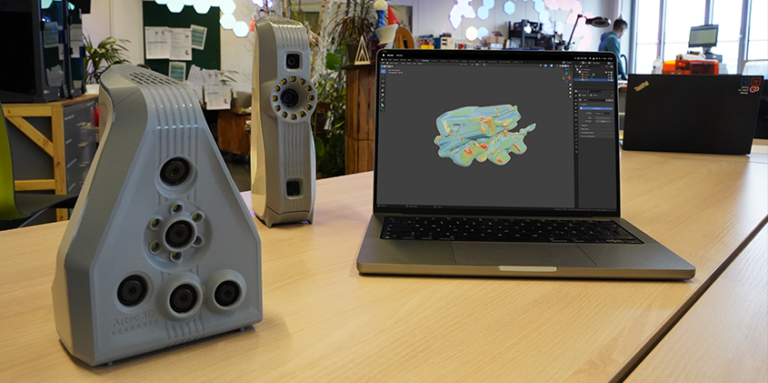
Utilizing advanced digital capture tools—such as 3D laser scanners, optical CMMs, structured light scanners, and CAD modeling software—reverse engineering bridges the gap between physical hardware and digital product design. This process ensures accurate geometry replication, enables design modifications, and streamlines rapid manufacturing workflows.
How the Reverse Engineering Process Works
- 3D Scanning & Data Capture: Acquiring high-density point clouds or mesh data from the physical component.
- Point Cloud Processing: Cleaning, aligning, and merging scan datasets into a watertight 3D mesh model.
- CAD Parametric Modeling: Converting mesh data into usable, fully editable surface or solid CAD geometry.
- Inspection & Validation: Comparing reconstructed CAD models against physical scan data to verify dimensional accuracy.
Key Benefits of Reverse Engineering
- Legacy Part Reconstruction: Recreates detailed CAD models for obsolete or undocumented components.
- Design Improvement & Customization: Allows engineers to modify existing products, improve ergonomics, or repair wear points.
- Seamless Prototyping Workflow: Provides precise digital models ready for 3D printing, CNC machining, or injection molding.
- Quality Control & Inspection: Identifies manufacturing deviations by comparing production parts to original CAD files.
- Accelerated Product Lifecycle: Reduces development time by building upon existing, proven physical designs.
Applications Across Industries
Reverse engineering is widely applied in automotive restoration, aerospace engineering, medical device customization, industrial tooling, and consumer electronics. Whether duplicating broken machinery components, digitizing handcrafted prototypes, or developing aftermarket parts, reverse engineering provides the essential data needed for modern precision manufacturing.